A tape of the following NPR 1995 broadcast was sent to me by guitarist, Jim Hall. He was interviewed via phone just after the death of Jimmy Raney in 1995. This was originally aired June 4, 1995 by National Public Radio (NPR) and several of Jim Hall's phone comments were aired. The host of the feature is Tom Cole.
Again this short broadcast about Jimmy Raney really spotlights how he was not truly appreciated for his major contribution to the legacy of Jazz guitar and jazz in general as evidenced by the commentary. It's very poignant and makes me a little sad when I listen to it--for many reasons. But I think everyone with an interest should hear it.
August 20, 2006


August 16, 2006
August 15, 2006
So what do YOU do when you're driving?
Many people have bad driving habits. Giving the finger, blabbing on the cellphone, fiddling for a station on the stereo, etc. Aside from the obvious vehicular dangers created, this doesn't seem like very worthwhile behavior. Dad was very good driver but one day he became intrigued by the low pitch he always heard when passing over the bridge. It was at a definite pitch and it was created by the tires passing over those little spaced rivets found on many bridges. Given his fascination for physics he set out to figure out how far apart these rivets were in order to produce the pitch he was hearing at the speed he was traveling. I don't remember the exact speed or the pitch he said it was but I do rememember that he told me after humming and figuring out the pitch, observing his constant speed and going home to calculate, he determined that the rivets were 5 and half inches apart.
This afternoon I figured it out with a spreadsheet and a hypothetical pitch. A440= 440 Cycles per second. The low pitch hum he was hearing was most likely two octaves below so let's say that he heard a low "A" at 110 cycles per second. In order to deterimine the rivet spacing distance you would first have to translate your car speed in miles per hour to inches per second. Then you would determine that unit distance in inches-based on the car speed you observed that produced the pitch you heard-that would have to be traversed 110 times in a second to produce that pitch. This is how I calculated the math:
cycles/sec to produce low "A" =110
speed: miles/hour=~42mph
speed: inches/sec=~605in/sec
unit inches to produce low"A" = 605/110=5.5
In other words if hypothetically, your constant speed produced a low A, then the speed in inches per sec to produce that would be ~605 in/sec (42mph)and it would have to pass over at least 110 rivets a second spaced 5.5 inches apart to do that.(605 inches/110=5.5 inches)
Nifty, huh?
This afternoon I figured it out with a spreadsheet and a hypothetical pitch. A440= 440 Cycles per second. The low pitch hum he was hearing was most likely two octaves below so let's say that he heard a low "A" at 110 cycles per second. In order to deterimine the rivet spacing distance you would first have to translate your car speed in miles per hour to inches per second. Then you would determine that unit distance in inches-based on the car speed you observed that produced the pitch you heard-that would have to be traversed 110 times in a second to produce that pitch. This is how I calculated the math:
cycles/sec to produce low "A" =110
speed: miles/hour=~42mph
speed: inches/sec=~605in/sec
unit inches to produce low"A" = 605/110=5.5
In other words if hypothetically, your constant speed produced a low A, then the speed in inches per sec to produce that would be ~605 in/sec (42mph)and it would have to pass over at least 110 rivets a second spaced 5.5 inches apart to do that.(605 inches/110=5.5 inches)
Nifty, huh?
The Monster cricket
In suburban Louisville where Jimmy Raney lived, there were a lot of crickets out at night. But at some point one of them managed to find a home right outside his front door of the apartment complex (perhaps in a door frame or nearby hallway plant). In the beginning he was curious how this cricket came to be displaced but with a small hallway as a sounding board, and with the cricket showing no signs of leaving, this nightly sound became quite irritating. Finally my father decided to take matters into his own hands. The next night when the cricket started his nightly song, he put a cassette tape recorder just behind the door with the mic turned up and recorded the chirping event for a good while. The next night, the cricket came back again right on schedule for another "recording session". But right in the middle, he flipped the recorder's play switch with the previous night's chirping AT FULL VOLUME. After letting the tape go for a bit, he turned it off and listened for the cricket. Nothing. complete dead silence.
Apparently, my father surmised, this cricket was faced with the realization that a gargantuan monster cricket was apparently living just on the other side of the door and that he had better make haste and find another chirping perch pronto if he knew what was good for him. Needless to say, Dad never had the cricket issue again and had probably established a modern and frightening cricket legend to be passed on to generations of young crickets to come.
Apparently, my father surmised, this cricket was faced with the realization that a gargantuan monster cricket was apparently living just on the other side of the door and that he had better make haste and find another chirping perch pronto if he knew what was good for him. Needless to say, Dad never had the cricket issue again and had probably established a modern and frightening cricket legend to be passed on to generations of young crickets to come.
August 14, 2006
Jimmy Raney's unfinished book
In the 80s, Dad starting doing more formalized teaching. More and more, he was invited to do jazz clinics, both in the US and abroad. I was fortunate enough to be able to get free room, board and classes at Attila Zoller's "bandcamp" nestled in his idyllic backwoods second home in Brattleboro, Vermont in 1982. There, I was witness to one of Dad's amazing lectures on polymetric phrasing. He also performed Bach duets with Ola Miracle his companion on piano, playing the flute part on guitar. He executed all the Baroque ornaments flawlessly and correctly.
Because of the new teaching demands, Dad began a manuscript on the construction of melodic line (circa 1983-1984). I saw a copy in progress when I stayed with him in 1985. Although the book was somewhat raw and perhaps in need of a bit more material, the book was nevertheless brilliant and original. Unfortunately, Mel Bay didn't see it that way and it was turned down for publication. I think he took the rejection hard because I didn't hear any more about it. Dad passed away in May, 1995 and I didn't see this manuscript again until last year. When I reread it, I was even more blown away by its potential.
The original manuscript is in good old fashioned xerox "mock-up" copy, in handwritten block print and pasted music examples- 31 pages in all. To date I have transcribed 15 pages into MS Word and have married jpeg snapshots of Finale files to the text copy. I also did some minor text edits, section summaries and a few footnotes.
As I discussed the project with friend and business partner Charles, he expressed the opinion that text manuscript with images alone may not be up to today's product delivery standard. Indeed, many jazz method books I see these days are available as pdf downloads, book and CD sets with recorded excerpts and even interactive programs either thru cd or a linked website. Although basic deliverable manuscript is "square one", the electronic version is our current goal and we're currently working towards this.
In terms of just the method book standard, the original manuscript at 31 hand-written pages is a little short of examples. Although he included some great samples, the typical Raney enthusiast undoubtedly will be looking for more of his signature recorded solos that demonstrate the concepts he discussed. This would've been my job to tell him as an editor: "More of your stuff, Dad!" "How about this solo?" "What about this phrase on Stella By Starlight?" and the like. When he was alive I think he considered my views of his oeuvre helpful. To this end, I have done some transcribing and plan on augmenting his work with the transcriptions. And not just his solos but some of his favorite players and influences, such as Parker and Getz. Both material selection and additional transcription will take extra time but I think it's well worth it.
My job here is really almost like finishing the "unfinished symphony". If he were alive today and had help what would he want to do? This is a big responsibility, however I feel stronger than every that during my lifetime I should do everything I can to trumpet his teachings and sing his praises. As if to say, "Hey there was genius in your midst and you blew it!" Here's your/our second chance to see.
Wish me luck!
Jon
Because of the new teaching demands, Dad began a manuscript on the construction of melodic line (circa 1983-1984). I saw a copy in progress when I stayed with him in 1985. Although the book was somewhat raw and perhaps in need of a bit more material, the book was nevertheless brilliant and original. Unfortunately, Mel Bay didn't see it that way and it was turned down for publication. I think he took the rejection hard because I didn't hear any more about it. Dad passed away in May, 1995 and I didn't see this manuscript again until last year. When I reread it, I was even more blown away by its potential.
The original manuscript is in good old fashioned xerox "mock-up" copy, in handwritten block print and pasted music examples- 31 pages in all. To date I have transcribed 15 pages into MS Word and have married jpeg snapshots of Finale files to the text copy. I also did some minor text edits, section summaries and a few footnotes.
As I discussed the project with friend and business partner Charles, he expressed the opinion that text manuscript with images alone may not be up to today's product delivery standard. Indeed, many jazz method books I see these days are available as pdf downloads, book and CD sets with recorded excerpts and even interactive programs either thru cd or a linked website. Although basic deliverable manuscript is "square one", the electronic version is our current goal and we're currently working towards this.
In terms of just the method book standard, the original manuscript at 31 hand-written pages is a little short of examples. Although he included some great samples, the typical Raney enthusiast undoubtedly will be looking for more of his signature recorded solos that demonstrate the concepts he discussed. This would've been my job to tell him as an editor: "More of your stuff, Dad!" "How about this solo?" "What about this phrase on Stella By Starlight?" and the like. When he was alive I think he considered my views of his oeuvre helpful. To this end, I have done some transcribing and plan on augmenting his work with the transcriptions. And not just his solos but some of his favorite players and influences, such as Parker and Getz. Both material selection and additional transcription will take extra time but I think it's well worth it.
My job here is really almost like finishing the "unfinished symphony". If he were alive today and had help what would he want to do? This is a big responsibility, however I feel stronger than every that during my lifetime I should do everything I can to trumpet his teachings and sing his praises. As if to say, "Hey there was genius in your midst and you blew it!" Here's your/our second chance to see.
Wish me luck!
Jon
August 10, 2006
I really should be practicing...
Once you've finally gotten that time to yourself, loosened your belt, grabbed some coffee, checked your email, dodged an instant mesage, killed a pop-up, logged off, patted the dog on his haunches, grabbed a hunk of cheese, had second thoughts about the expiration date of said cheese, glanced over at the dog and his look of disapproval (he would've enjoyed the cheese more than you) flashed back on something that went wrong at work, contemplated that look of disapproval from your boss (he would've enjoyed the day more without the f### up), ruminated on the possibility of something inherent to your thinking patterns that get you into these kinds of messes, perhaps genetically based...
You get the idea, the mind is complicated. It is an interactive and reactive machine and it can lead you into some wild places in the blink of an eye. Likewise a practice session can go south with a lot of tangental and distracting thoughts. Part of this is a good thing, because the mechanics of these mental processes are used when you're in the act of performing, and requires access to a lot of different information at once, quickly. So how to you hone and harness this process and get it started on the right foot?
One of the things you should do is listen to your favorite music before you start practicing. This can be inspiring enough to lead you straight to the instrument with a clear head and positive thoughts of the possibility of you approaching being able to play like that...eventually.
Work on something you have difficulty with. But approach it analytically. Learn to isolate down to the smallest detail. A left hand fingering, a hand preparation, a small transition. Realize you are asking a great deal of the brain to play a passage. It is doing things faster than you can think about and is relying on the information you supply it.
Be prepared to work through a block. Apart from the regimental things you might do when practicing, one of the things you are seeking is a complete and direct communication with the sounds in your head and the process of translating that to the fingers. You are seeking a state of doing, not think-doing. Until you start approaching that, you are not operating with all of your faculties available.
Try to avoid repeating a passage over and over again wrong. A mistake can be remembered as well. Remember the process of playing is literally drawing on mental-physical copies of the task programmed in. So if you put in a bunch of bad copies, like a computer, your chance of retrieving a bad copy are high. You want to basically overwrite a bad copy with enough good copies (your mind has no delete, empty recycle bin button that I know of. Although Tom Cruise might insist there is.
Try tranposing things you learn by ear. In the case of songs, this leads to an overall sensation of "distance" to travel on the keyboard. Eventually it becomes a physical act of interval distance recognition by feel. The feeling of being able to play anything in any key by ear leads to a general increase in confidence level in playing situations. Like Staples, "That was easy" goes a long way for the psyche.
Practice playing with your eyes closed. Take note of what you miss, but also note how much many ideas you can play correctly by touch and body distancing. Blind people can play. So can you. You might find you are much more focused on the sounds and the physical job when your eyes and all of its distractions are disengaged.
Make sure to pick-up where you left off when you practice. If possible notate something that you can go to. I recall recently an exercise I devised for left hand 3 voice chords that I was sure I would remember. I didn't.
Record your practicing. With all the latest gadgets that is becoming easier to do. It's painful but it does give you a more objective viewpoint on what you sound like. If too painful, listen to it in a few days. Remember you are using the recording as an unedited document of your experience. You locate a point where you were trying to do something and you sit down and redo that moment again so this time it does what you wanted it to do.
One of the problems with playing issues is just your perception of your abilities. When you succeed at dominating there is just the gestalt of doing something right that gives you the necessary attitude to build upon an experience of something as achieved.
You get the idea, the mind is complicated. It is an interactive and reactive machine and it can lead you into some wild places in the blink of an eye. Likewise a practice session can go south with a lot of tangental and distracting thoughts. Part of this is a good thing, because the mechanics of these mental processes are used when you're in the act of performing, and requires access to a lot of different information at once, quickly. So how to you hone and harness this process and get it started on the right foot?
One of the things you should do is listen to your favorite music before you start practicing. This can be inspiring enough to lead you straight to the instrument with a clear head and positive thoughts of the possibility of you approaching being able to play like that...eventually.
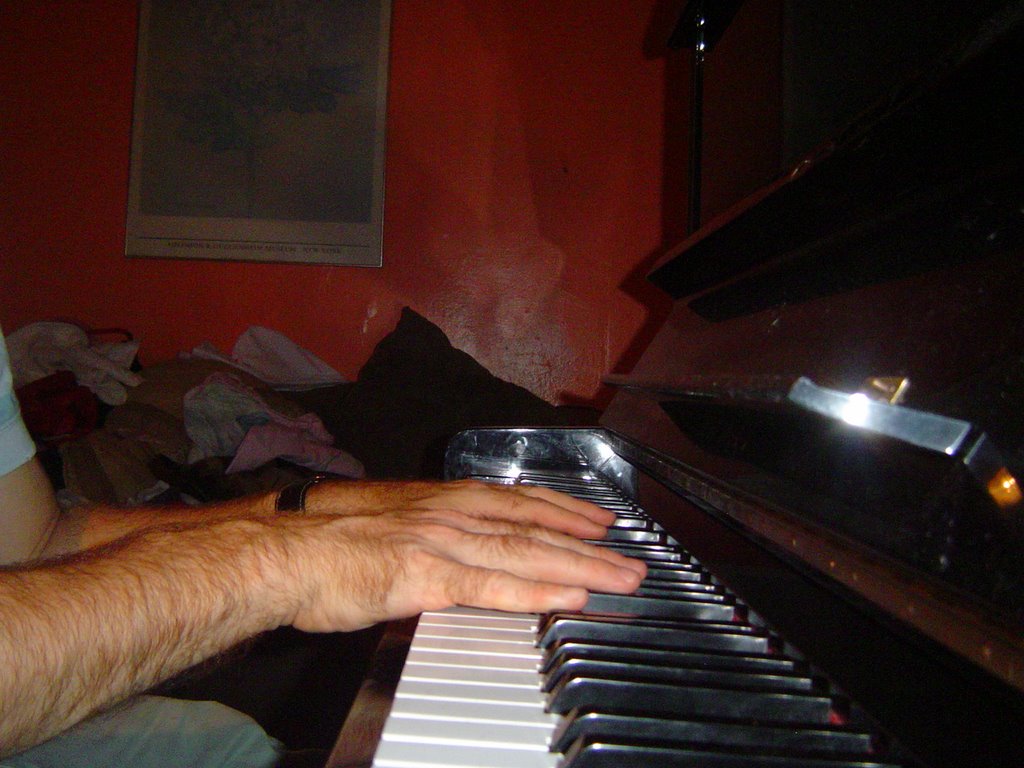
Work on something you have difficulty with. But approach it analytically. Learn to isolate down to the smallest detail. A left hand fingering, a hand preparation, a small transition. Realize you are asking a great deal of the brain to play a passage. It is doing things faster than you can think about and is relying on the information you supply it.
Be prepared to work through a block. Apart from the regimental things you might do when practicing, one of the things you are seeking is a complete and direct communication with the sounds in your head and the process of translating that to the fingers. You are seeking a state of doing, not think-doing. Until you start approaching that, you are not operating with all of your faculties available.
Try to avoid repeating a passage over and over again wrong. A mistake can be remembered as well. Remember the process of playing is literally drawing on mental-physical copies of the task programmed in. So if you put in a bunch of bad copies, like a computer, your chance of retrieving a bad copy are high. You want to basically overwrite a bad copy with enough good copies (your mind has no delete, empty recycle bin button that I know of. Although Tom Cruise might insist there is.
Try tranposing things you learn by ear. In the case of songs, this leads to an overall sensation of "distance" to travel on the keyboard. Eventually it becomes a physical act of interval distance recognition by feel. The feeling of being able to play anything in any key by ear leads to a general increase in confidence level in playing situations. Like Staples, "That was easy" goes a long way for the psyche.
Practice playing with your eyes closed. Take note of what you miss, but also note how much many ideas you can play correctly by touch and body distancing. Blind people can play. So can you. You might find you are much more focused on the sounds and the physical job when your eyes and all of its distractions are disengaged.
Make sure to pick-up where you left off when you practice. If possible notate something that you can go to. I recall recently an exercise I devised for left hand 3 voice chords that I was sure I would remember. I didn't.
Record your practicing. With all the latest gadgets that is becoming easier to do. It's painful but it does give you a more objective viewpoint on what you sound like. If too painful, listen to it in a few days. Remember you are using the recording as an unedited document of your experience. You locate a point where you were trying to do something and you sit down and redo that moment again so this time it does what you wanted it to do.
August 3, 2006
Things Downbeat Never Taught Me
Back in 1939 or 1940, when I was just starting out to be a jazz musician, I was a Downbeat and Metronome freak. I devoured these two magazines in search of news of my heroes. I'm not talking about Benny Goodman or Artie Shaw. They were household words to everybody, as the Gabor sisters, The Grateful Dead and Kentucky Fried Chicken are today. I'm talking about the guys who played jazz on offbeat labels. I knew they all lived in New York City, and had penthouses overlooking Central Park. I went to the movies and saw jazzmen (portrayed by Cary Grant and David Niven) doing just that. I figured maybe I could do that too, if I just kept practicing my hot licks. That's what they called them back them--honest.
Louisville in those days was different than today. Back then there were only a half a dozen musicians who could play jazz, but couldn't make a living at it. Nowadays there are at least ten times as many who can't make a living at it. Louisville has come a long way.
Anyway, from reading Downbeat, I figured the only hope I had was to get to New York. I knew there weren't any penthouses here, not to mention Cary Grant or David Niven. Since I didn't have any money but did have and uncle and grandmother in Chicago, I thought I would try there first. It did have tall buildings, a lot of people, and Downbeat was published there, even if they only wrote about musicians in New York, they wrote it there.
Chicago turned out OK. There were a lot of talented young musicians, and they all played bebop. They didn't get paid for it though. Nobody like bebop. Not the jazz fans, not the older musicians, not even the Downbeat writers. We mostly played for free in a B-Girl joint on South State Street called the "Say When". They didn't like bebop either, but they let us play there to make the place look like a real club, instead of a clip-joint that rolled drunks who were looking for some action. They got action all right, but not the kind they had hoped for. They ended up in the alley with a sore head and no money. The bartenders were all ex-prizefighters--they had to be.
I finally found a place where I got paid to play. It was called Elmers, and it was on State Street too, but not on South State Street, but right in the heart of the Loop. The leader of the trio was a man named Max Miller. His age placed him in the Dixieland-swing era, but his style was an unidentifiable creation of his own devising, and was more dissonant and modern sounding than either. He was a fierce looking man with a black walrus mustache, and a menacing, venomous grin. He was stocky and powerful and had a vile temper, and as a consequence everyone gave him a wide berth. He was an accomplished vibraphonist but preferred to play the piano, on which his technique was quite limited.
He had created a repertoire of originals and had quite a following. At least more than enough to fill his small club. The bandstand was located in the center of a semi-circular bar, and we hammered out his collection of peculiar pieces with such titles as: Heartbeat Blues, Blues for Beethoven, and many others whose names I have long since forgotten. For some reason he was quite fond of my embryonic bebop efforts, and treated me very nicely for a time. Our bassist was another young bebopper named Gary Miller, and Max really gave him a hard way to go for reasons I couldn't fathom. Max would play some figure in his left hand and glare at Gary saying, "Dig this riff." Gary, who had absolute pitch, would pick it up instantly. After a few bars Max, would shout at him, "Get off my road." And so it went. No matter what Gary did, he couldn't please him. It ended finally when a Downbeat writer came in to see us and asked Gary if he was any relation to Max. Gary, whose real last name was Malemud, said "He's my father", and the writer printed it. C'est finis pour Gary. A little while later it came to be my turn on the rack, and since I thought I played better than he did, I wasn't having any--money or no--so we parted company.
There was another style going at the time in Chicago. This was the Lenny Tristano style. We beboppers didn't think much of Lenny, and vice versa. As far as I could figure out, nobody liked Lenny's music except Lee Konitz and his mother. (Lenny's mother, not Lee's.) He hated our music and we hated his, and everyone else hated all of us. Lee and Lenny left for New York City soon afterward, so we had the unpopular music scene all to ourselves.
After awhile, I got lucky. It seems that bebop was beginning to make some headway in New York, in spite of the critics, and some of our boys were working on 52nd Street. A couple of them had heard me in Chicago and recommended me for the guitar chair in Woody Herman's new bebop band.
It was a great band, but there wasn't much for me to do. I scratched around on my old rhythm guitar while my electric Charlie Christian model Gibson sat idly by. There weren't many guitar solos for me to play. Finally Ralph Burns and Al Cohn took pity on me and wrote a few things. Anyway I knew my penthouse was still waiting if I could only get to New York to claim it.
After about eight to nine months on an old bus I was ready to cry uncle. They never told about this in the Glenn Miller movie "Orchestra Wives." There were a lot of disillusioned orchestra wives with us too.
I stayed in New York after that. I figured I was ready to conquer the Apple and lay claim to my penthouse in Manhattan. We didn't call it "The Big Apple" then. I think that was invented by mayor Koch and his P.R. men.
Things got better after that. I had made my first record with Stan Getz. I played it a lot. Looked at it a lot. Just think! I was one of those guys who had made a record for an offbeat label. Maybe there were kids out there wishing they were me. I made some more records with stars such as Buddy DeFranco and Terry Gibbs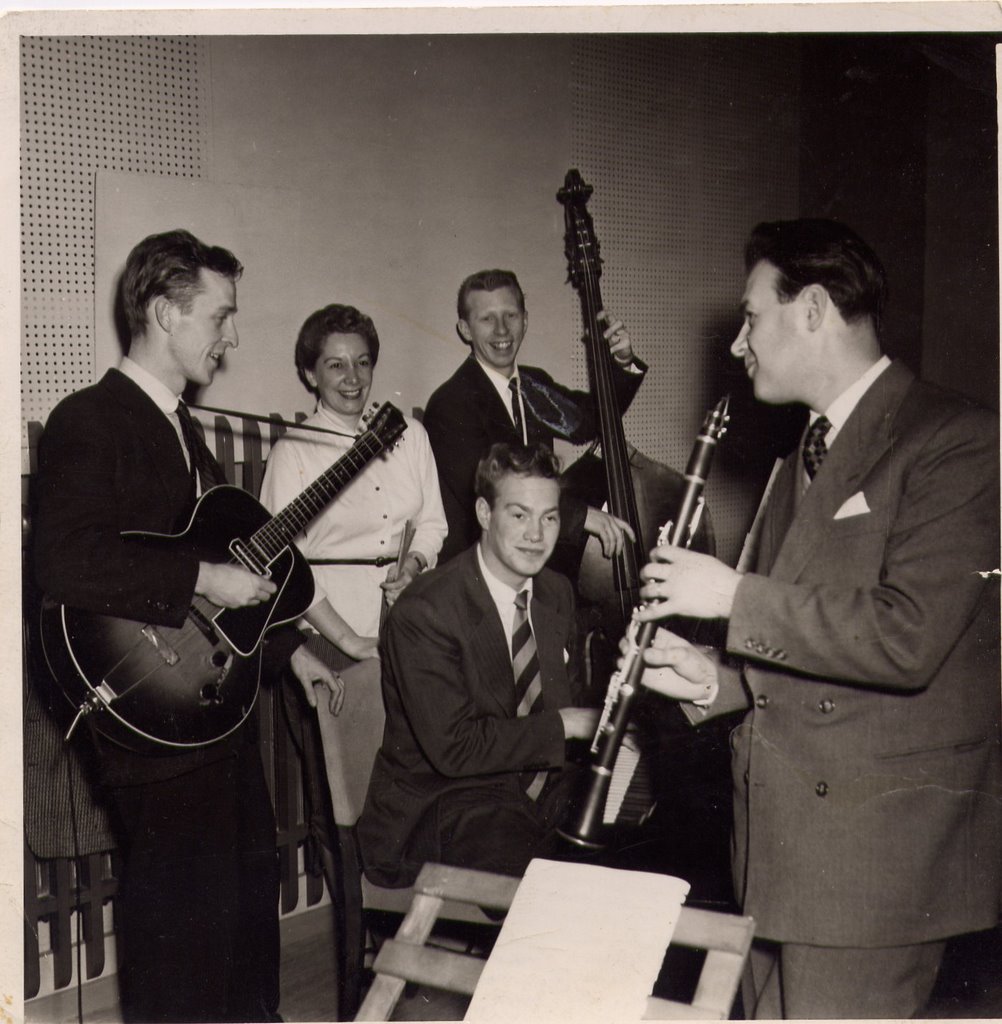 . I even worked jobs at Birdland with them. Still, all I had was a furnished room on 81st street and less money in the bank. By the time I got down to $60 I really started to get worried. I had started out with $2000 in 1948 dollars.
Artie Shaw came to my rescue by hiring me for what was to be his last big band. It was a fine band, as good as Woody's and I got much more to play. I was afraid of him because I had heard how tough he was to work for, but it wasn't true. If you could play he didn't bother you. He seemed to care only about the music.
Unfortunately, the people didn't care only about the music. In fact, they didn't like what we were doing. They wanted to see the man who had married so many movie stars, and hear Begin the Beguine and Frenesi. He broke up the band and I was back in my furnished room with a somewhat smaller stash of 1949 dollars. I was getting a little better known around town by now. I worked maybe once a month instead of every three months. I was starting to get calls from people out of town and Europe wanting to find out which of the glamorous Manhattan jazz clubs I was appearing in nightly. My first telephone was my one tangible sign of success and adulthood, but I began to hate it. I started answering my phone by saying, "Grand Central Roach Control."
I played and recorded with Stan Getz in 1959, '51 and '52. Then I did a one-and-a-half year stint with the Red Norvo trio. After that I got married and settled down in New York City. I found out soon enough that you can't make a living playing jazz in one city. Not even New York City, so I started doing other things in order to get by. TV jingles, club dates, recordings--both commercial and jazz-along with other stuff. I even did subs, and played the full run of two Broadway shows. That's the nearest thing in music to stuffing mattresses for a living.
I met and played with several of the older musicians whom I had admired so much when I was starting out in Louisville. I met them while making TV jingles. Alas-they were in the same boat as I. I can't complain though; I did make a living, and a pretty good one at that. I made a lot of jazz records over the years. Around fifty under my own name at last reckoning, and many more than that with other people, so I did OK after all. There were many who didn't.
I never did get my penthouse, and I never met another jazz musician who had one either. I did visit a few now and then. They belonged to millionaire stockbrokers and the like. Perhaps it's just as well I didn't. I most likely would have fallen off the terrace when I was drunk.
See you in the funny papers--or maybe Downbeat.
J.R.
Subscribe to:
Posts (Atom)